



Vegan fashion: what it really is and how it’s produced
The vegan fashion has become one of the keywords of contemporary fashion. We find it on the labels of bags, in e-commerce descriptions, in the campaigns of major brands that want to tell a green story. Yet, behind this term, lies a world much more multifaceted than one might think. We sometimes come across products labeled as "vegan leather" that are actually little more than coated plastic, and others—less publicized—that instead represent the best of bio-based research in recent years.
Let's start with the basics: what does vegan fashion include
It includes materials that derive from natural organic matter or organic production waste, but without involving animals in any phase of the production process.
The problem arises immediately after. Because the "vegan" label, by itself, tells us nothing about the origin of the material. A PVC bag is vegan. A polyurethane bag is vegan. And a bag made with apple peels recovered from the Tyrolean juice industry is also vegan. Three completely different products, with diametrically opposed environmental impacts, all united by the same label.
This is why "vegan fashion" is not enough. We must always ask: what type? What material? What is the bio-based content? These are the questions that separate conscious shopping from greenwashing.
How vegan leather is made: the production processes
There is no single way to produce vegan fashion, and this is the first thing to keep in mind. Every type has its own supply chain, with technical specificities that change radically from one material to another.
Very simply put, we can say that the process always starts from a raw material—which can be an organic food waste, a plant fiber—and results in a finished fabric through steps of drying, grinding, mixing with binding agents, and laminating onto a support (usually certified organic cotton or recycled polyester through plastic recovery activities from the oceans or similar circular activities).
In the case of plant-based materials, we start from agricultural waste or food byproducts, such as peels, leaves, and powders that are dried, reduced to very fine particles, and then mixed with biopolymers or natural resins. The compound is processed until a flexible surface is obtained, with textures similar to traditional ones.
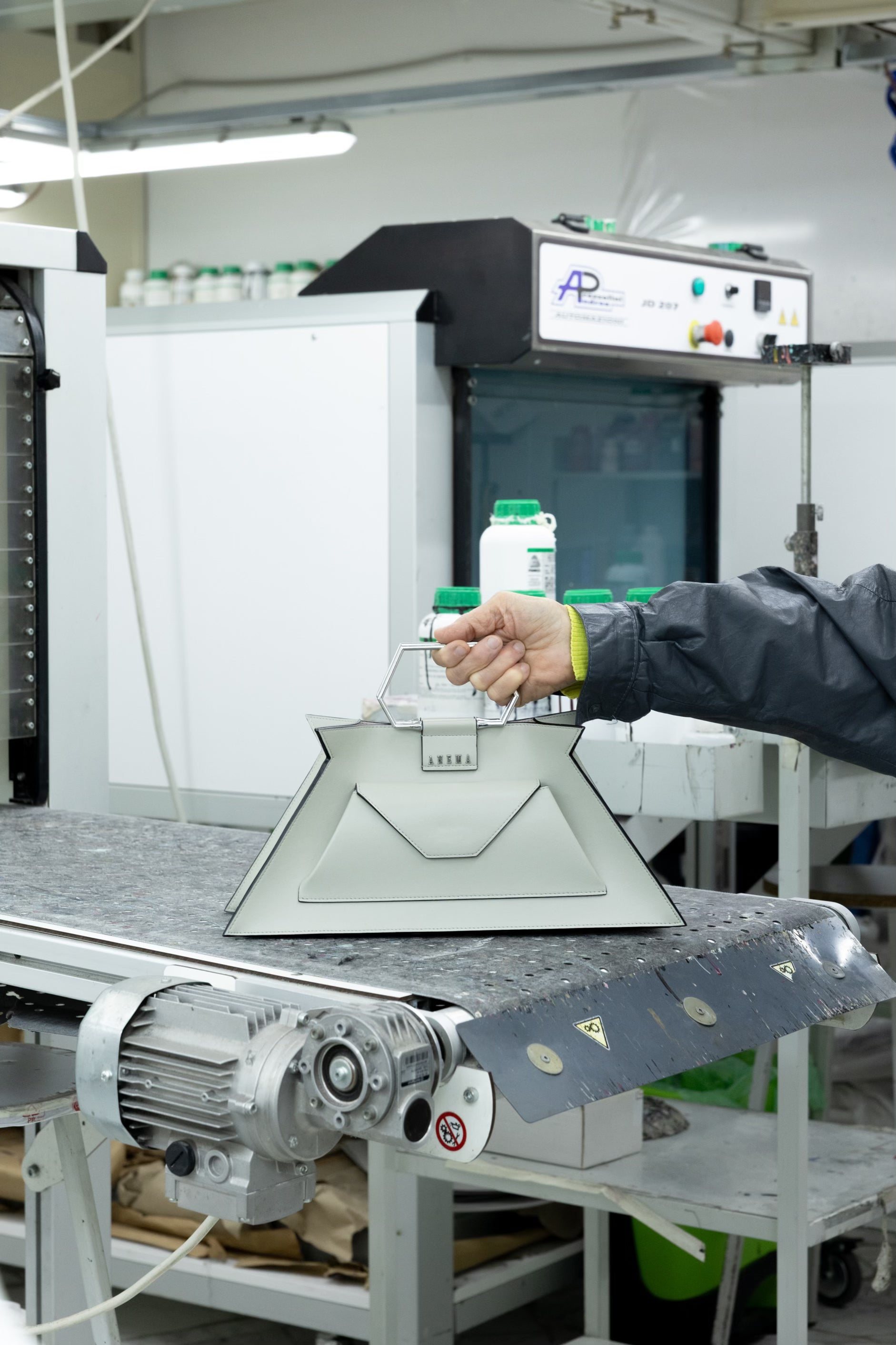
Some brands choose total transparency about this process. Anema Bags, for example, openly declares which fabrics it uses, where they come from, and with which industrial partners it collaborates. Those who want to learn more will find everything documented in the Anema philosophy and lifestyle: a level of detail that today, let's face it, is by no means taken for granted.
An overview of the types of plant-based vegan materials
This sector has grown enormously in the last ten years. What until recently was an experimental niche has become a real industrial sector, with patents, international certifications, and consolidated supply chains. Let's look at them one by one, the materials that are rewriting the rules.

Cactus fibers (Desserto)
Desserto is perhaps the most iconic name of this innovative wave. It comes from Mexico—specifically from the state of Zacatecas—and is obtained from the Nopal cactus, a plant that practically grows on its own: it does not require irrigation, makes use of seasonal rains, and regrows on its own between one harvest and the next.
The mature leaves are cut every 6-8 months, respecting the plant's biological cycles. Then the process: sun drying, grinding, mixing with non-toxic binders, laminating. PETA approved certified, partially biodegradable, suitable for high-end products.
The cactus fiber bags have become, in just a few years, one of the most desired items for those who carefully follow sustainable fashion.
Apple peels (Uppeal / Coronet)
Let's move to South Tyrol, the land of apples par excellence. From the juice industry—and its inevitable waste—one of the most interesting plant leathers of the moment is born. Pomace, that is, what remains of the apple after juice extraction, no longer ends up in landfills: it is dried, powdered, mixed with biopolymers, and transformed into a material we call apple peel.
It works well for both accessories and clothing. It has a high renewable content, is PETA approved vegan. An almost educational example of circular economy: an agricultural waste that becomes a design object. The apple peel bags have a particular charm, perhaps because they tell a story that starts from the land, all the way to us.
Orange fibers (Ohoskin)
From Catania comes Ohoskin, a material born from Sicily's citrus groves and its rich industrial tradition. The principle is the same as apple peel: recover the waste—in this case, orange peels and residues—to transform them into an innovative fabric.
The result is a bio-based material, renewable, even carbon positive. The texture is velvety, the finish premium. The orange fiber bags are the most refined expression of what we technically call industrial symbiosis: when two sectors—agriculture and fashion—truly talk to each other, and reinforce each other.
Corn fibers and recycled PET
Here we enter a hybrid territory. Some innovative fabrics combine an organic base derived from corn with recycled polyethylene terephthalate fibers, recovered in environmentally at-risk areas such as polluted coastal areas or marine plastic basins, complex and circular recovery activities that enhance the technicality of the study on the aforementioned hybrid materials.
The corn fiber and PET bags are a fascinating synthesis: accessories born to reduce two problems simultaneously, dependence on petroleum derivatives and plastic pollution.
Mushroom fibers (Mylo and Muskin)
This is perhaps the most surprising frontier. Mylo is a material obtained from mycelium, the network of very thin filaments that makes up the underground part of mushrooms. Muskin, on the other hand, is derived directly from the cap of certain selected mushroom species.
The truly remarkable thing? These materials are grown. In a controlled environment, the mycelium grows in a few days. Biodegradable, with very low resource requirements, and minimal environmental impact. It is no coincidence that it is attracting investments from major international luxury groups, which see these mushrooms as a material of the future.
Pineapple fibers (Piñatex)
From the Philippines comes Piñatex, one of the first plant leathers to be launched on the international market with a structured supply chain. It is derived from the fibers of pineapple leaves which, traditionally, after the fruit harvest, were simply burned or left to decompose.
By recovering this waste, Piñatex does not require additional land, water, or fertilizers. And—a non-minor detail—it generates additional income for the farming communities that grow pineapples. A technological innovation that also has a concrete social impact.
Other innovative materials
Hemp deserves a chapter of its own, which technically is not a "coated material" but a fabric, and which represents one of the most extraordinary natural fibers we have at our disposal. Unbeatable resistance—it is the strongest plant fiber of all—ability to hold dyes better than any other natural fabric, intrinsic antibacterial properties. It grows quickly, without the need for pesticides, on soils that other crops often do not enhance.
The organic hemp bags made with GOTS certified Italian hemp are a little jewel of textile engineering: they last for years, develop a patina over time, and acquire character. Quite the opposite of fast fashion.
And then the experimentation continues. Fibers from coffee, algae, grape pomace, kombucha. Something new arrives on the market every year. It is difficult to predict which materials will dominate in five or ten years, but one thing is certain: waste, wherever it is produced, is a resource.
Vegan fashion and eco-leather: they are not the same thing: the differences
Vegan fashion and eco-leather are often used as if they were synonyms, but they are not at all. Eco-leather is a subcategory of animal leather. Simply, it is animal leather produced with tanning processes that are less polluting than traditional methods, according to specific environmental parameters. In Italy, the term has been regulated since 2020: only products that meet certain standards can be called "eco-leather".
But beware: eco-leather does not mean vegan. The origin of the raw material is always animal. Therefore, those looking for a cruelty-free product must look elsewhere.
Vegan fashion, on the contrary, excludes by definition any animal raw material. It can be synthetic or plant-based. They are different worlds, even if the designation is the same.
Synthetic fashion versus vegan fashion: the issue of impact
A question that often comes up: if synthetic leathers are all vegan, why distinguish them? The reason is the environmental impact, which changes drastically.
Conventional synthetic leathers—PVC, standard polyurethane—derive from petroleum. In production, they release polluting substances, at the end of their life they do not degrade (or they do so in geological times), and they represent one of the most underestimated contributions to microplastic pollution. Technically cruelty-free, yes. Sustainable? Much less.
On the other hand, plant fibers start from renewable biomass. Their environmental impact is, on average, a fraction of that of synthetics. And some—like Uppeal or Desserto—are also biodegradable, at least partially.
Is vegan fashion always a sustainable choice?
After everything we have said, the answer should be quite clear. No, not always. It depends on the type of vegan material, the production process, the supply chain, and the transparency of the brand.
The "vegan" factor is not enough on its own to guarantee sustainability: it is a necessary but not sufficient condition.
So let's learn to look beyond the superficial label, learn to value those who work seriously. Sustainability is a journey, not a label.
Recognizing quality vegan fashion: some tips
There are some fairly reliable signs to understand if what we have before us is a serious product.
First: certifications. PETA Approved Vegan for cruelty-free, GOTS for natural fibers, certifications on bio-based content. Equally important is transparency about materials. A well-made label tells you exactly what the bag is made of, in what percentage, and with what type of support.
Let's not forget the tactile sensation. Good plant leathers have a rich texture, a deep color, and refined finishes. They have their own character.
Those who want to start understanding this world can take a look at the eco-sustainable vegan bags: it is a good way to understand, concretely, what it means today to make fashion with conscience.
FAQ
Does vegan material last over time?
It depends a lot on the material. Quality plant coatings have good durability, in some cases comparable to traditional materials. Cheap synthetics, on the other hand, tend to peel or crack with use. As always, the care we give to the accessory makes a huge difference.
How do you clean a bag made of vegan material?
Generally, a soft, slightly damp cloth is enough. It is better to avoid harsh solvents and chemical detergents, which can alter the texture, especially on plant fibers. For stubborn stains, it is always better to follow the manufacturer's specific instructions.
Is it water-resistant?
Most plant fibers have good moisture resistance, and almost all are completely waterproof. It is still better to avoid prolonged exposure to rain and dry any drops immediately.
To conclude
What we have seen today is just a primer on how rich and layered the world of vegan fashion is. Behind a word that seems simple lie stories, research, supply chains, ethical choices. The real change, after all, always happens one step at a time.

Written by Francesco Esposito


